Showing posts with label Conan Doyle. Show all posts

Saturday, 1 October 2011

Giants walking the Strand

The Strand in London stretches from Trafalgar Square to Fleet Street, full of names that evoke romance in the lovers of English literature. Still a part of the theatre district, the cultural vibes resulted in substantial readings on the literary Richter scale in the nineteenth century when it became the preferred place to stay for the then avant-garde thinkers and writers including – Charles Dickens, William Makepeace Thackeray, John Stuart Mill, Thomas Carlyle and Herbert Spencer. Ralph Waldo Emerson spent a few days as a guest in the locality and Virginia Woolf was enraptured enough by the bustle and colour of the thoroughfare to make it the setting for an epochal moment of Mrs Dalloway, when Elizabeth comes to understand the purpose of her life.

Tucked away in the adjoining Southampton Street, in the periphery of the Theatre district, stood the offices of the famed Strand Magazine named after the street. Established in 1891 by George Newnes and phenomenally popular as a delightful monthly platter of stories, articles and puzzles, it gave birth to the gentleman thief “Raffles”, created by Ernest William Hornung, and also included among the contributors writers of the stature of Dorothy L Sayers, Agatha Christie, Margery Allingham, H.G. Wells, E.C. Bentley, Rudyard Kipling, Georges Simeon, Edgar Wallace, Max Beerbohm , E. Nesbit, W.W. Jacobs and many others.  Readers used to line up outside the 7-12 Southampton Street offices of the magazine waiting for the next instalment.

However, the two giants who strode like twin Colossuses in the first quarter of the Twentieth century for the magazine were P.G. Wodehouse and Arthur Conan Doyle.

Sherlock Holmes short stories appeared in the pages as did a lot of Jeeves and Wooster capers. When Conan Doyle killed off Sherlock Holmes, although we can say temporarily in hindsight, in The Final Problem, 20,000 people cancelled their subscriptions.

When, however, Conan Doyle decided to reinstate the detective in his Baker Street residence, citing some far off travels during the hiatus including interactions with the Dalai Lama, the Strand was obviously delighted. A twenty two year old Wodehouse, a dabbler in many forms of literary expressions in those days, wrote a fascinating poem to welcome the sleuth back to the premises. Named Back to his Native Strand, it contains the following lines:

When Sherlock left his native Strand, such groans were seldom heard;
With sobs the Public’s frame was rent; with tears its eyes were blurred.
                But optimists reflected
                That he might be resurrected
It formed our only theme of conversation.
We asked each other, Would he be, and if so How and where?
We went about our duties with a less dejected air.
Location of the offices of The Strand
                And they say that a suggestion
                Of a Parliamentary question
Was received with marked approval by the nation.
And Sherlock, Sherlock, he’s in town again,
Sir Conan has discovered him, and offers to explain.
                The explanation may be thin,
                But bless you! We don’t care a pin,
If he’ll but give us back our Sherlock.


Perhaps because it was a four-minute walk from the Strand Magazine office, both these authors placed several of their fictional encounters in the Simpsons in the Strand, one of the oldest traditional English restaurants.

Simpsons 
Part of the Savoy Hotel, Simpsons is now famous for its roast meats, and before being taken over by Savoy, was home to 19th century chess encounters between the grandest names including Steinitz, Morphy, Lasker and Tarrasch.

At the end of The Adventure of the Dying Detective, in which Holmes pretends to be down with fatal Oriental fever in order to lure the villain into a cocoon of security, the consulting sleuth says, “When we have finished at the police station I think something nutritious at Simpson’s would not be out of place.”
In The Illustrious Client, Watson arranges to meet Holmes at Simpsons and finds him ‘sitting at a small table in the front window, and looking down on the rushing stream of life in the Strand.’

Several paragraphs of Something New by P.G. Wodehouse are devoted to the restaurant. And two of the earliest heroes of his fiction for grownups, Mike and Psmith in the novel of the same name, dine there after ‘Psmith waited for Mike while he changed, and carried him off in a cab to Simpson's, a restaurant which, as he justly observed, offered two great advantages, namely, that you need not dress, and, secondly, that you paid your half-crown, and were then at liberty to eat till you were helpless, if you felt so disposed, without extra charge’. In Cocktail Time, Cosmo Wisdom has lunch there after leaving prison.

However, Strand and the restaurant apart, and the Charing Cross, Paddington, Waterloo and the other stations from where characters created by both of them get on the trains for the countryside, the two Strand stalwarts depicted rather different parts of London in their novels.

While a probable lack of confidence in the Geography of London made Sir Arthur restrict most of his significant events around Charing Cross and the Strand, P.G.Wodehouse, in his many many novels and short stories, is more peppered across the city, while being somewhat inclined to use Mayfair as his base. In fact, in The Mating Season, Bertie Wooster is referred to as the Mayfair Consultant.


Let us take a trip with the two authors in and around London and some idyllic locales of England.

The Sherlock Holmes Walk                                 
The PG Wodehouse Tour


Following Sherlock Holmes around London


A Sherlock Holmes Walk around London  


- Arunabha Sengupta


At 221-B Baker Street, the most famous detective continues to live, enjoying celebrity status around the world.  Alighting at the Baker Street tube station, one finds his profile, pipe, deerskin cap an checked coat, looking from the corner of his eye, from the tiles that make up the station walls. 


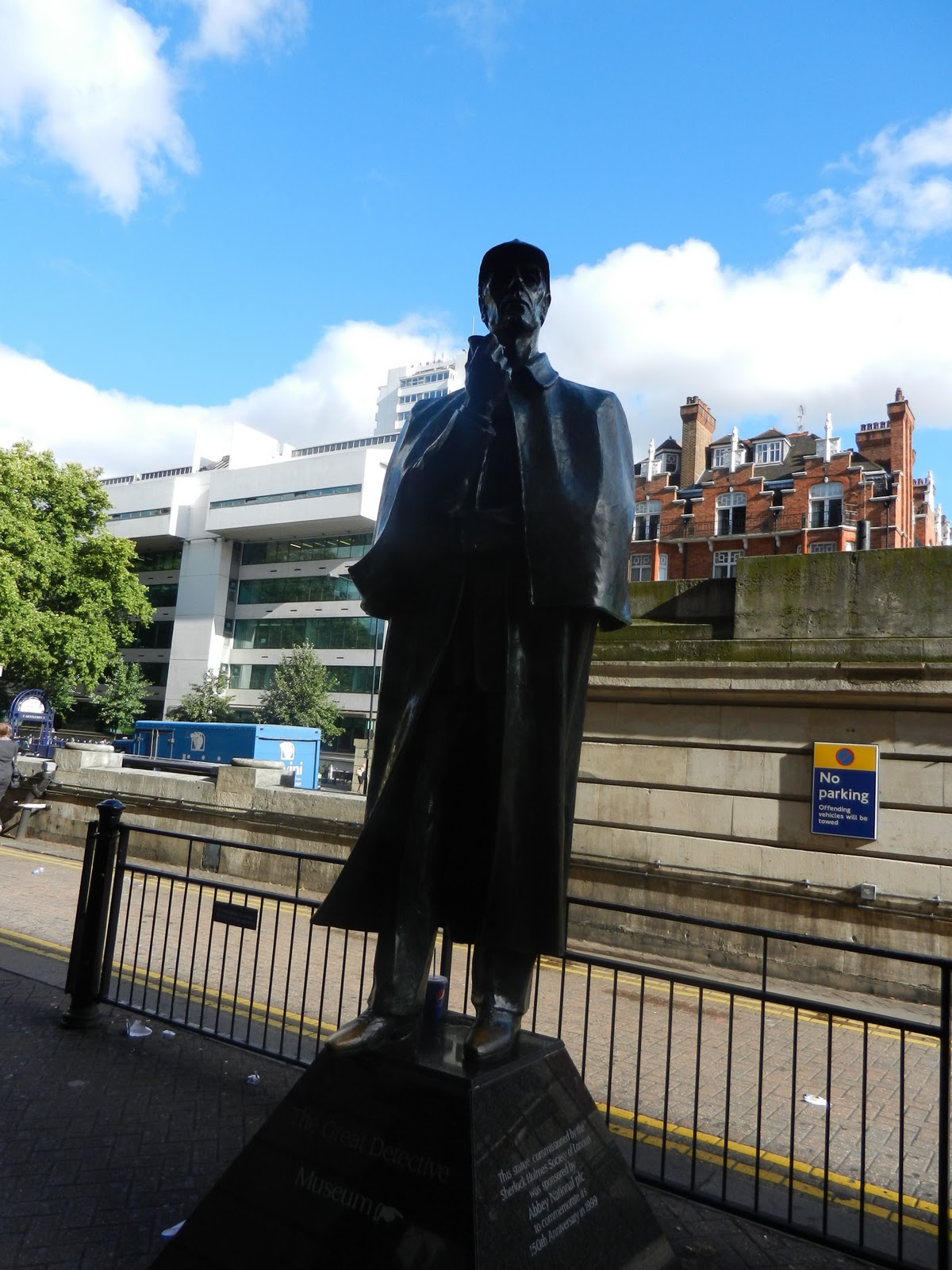
Stepping outside, one sees the larger than life statue of the sleuth looking on at the passing traffic of Marylebone Road, fast cars and double decker buses having long replaced the beloved hansoms.

Japanese admirers of Holmes
When one follows the signs and reaches the museum at the most famous address of London, perhaps even with 10 Downing Street in contention, one sees a sign proclaiming it to be the residence of the consulting detective Sherlock Holmes. On pausing a minute of so, the international reputation of the man is revealed as the picture of this signboard is clicked by the Sonys, Fujis and Nikons of hundreds of Japanese tourists. 


Tickets to the museum are available from the Sherlock Holmes shop next door, which contains quaint collectibles – replicas of London double-decker buses, Sherlock Holmes busts and clocks, and free visiting cards of the detective.
The museum itself actually lies between numbers 237 and 241, but bears the number 221B, the literary discrepancy approved by the authorities. It is designed and maintained exactly as Holmes and Watson may have found it in the late nineteenth century.  Sherlock Holmes’ deerskin hat hangs near the doorway, cloth caps and pipes lie on old mahogany tables, tea pots, books, magnifying glass, hour glass, violins, barometer, shoe brush, measuring tapes and ancient revolvers are scattered around on the furniture, show cases and walls. One also finds a knuckle duster and recreated paraphernalia from the canon.
A stuffed mannequin of a Baker Street Irregular stands in the lobby.


The third floor is full of life size stuffed replicas of various characters of the novels and stories, including Holmes, Watson, the man with the twisted lip, Irene Adler, Jabez Wilson and many others. Another version of Dr. Watson sits in the sofa, and I think he is an animated mannequin who moves his eyes over the pages of a notebook. When I look back at him, he smiles and says, “Hello, I am Dr. Watson.” A nice touch.

Site of the Empty House
Coming out of Baker Street and walking south, one crosses the Merylebone Road and pauses in front of 118 Baker Street, currently next to a Travel Agency. It is the location of the Camden House, an empty building opposite the Baker Street residence of Holmes and Watson, where they wait to surprise Colonel Sebastian Moran in The Empty House.
Walking further east, through the Manchester Square, brings us to the intersection of Bentinck Street and Welbeck Street, where Holmes is almost run over by a van driven by Moriarty’s men in The Final Problem.

Welbeck and Queens
Turning right at Welbeck Street, we reach Queen Anne Street, where Watson takes rooms after moving out of the Baker Street lodgings in The Illustrious Client.


Langham Hotel
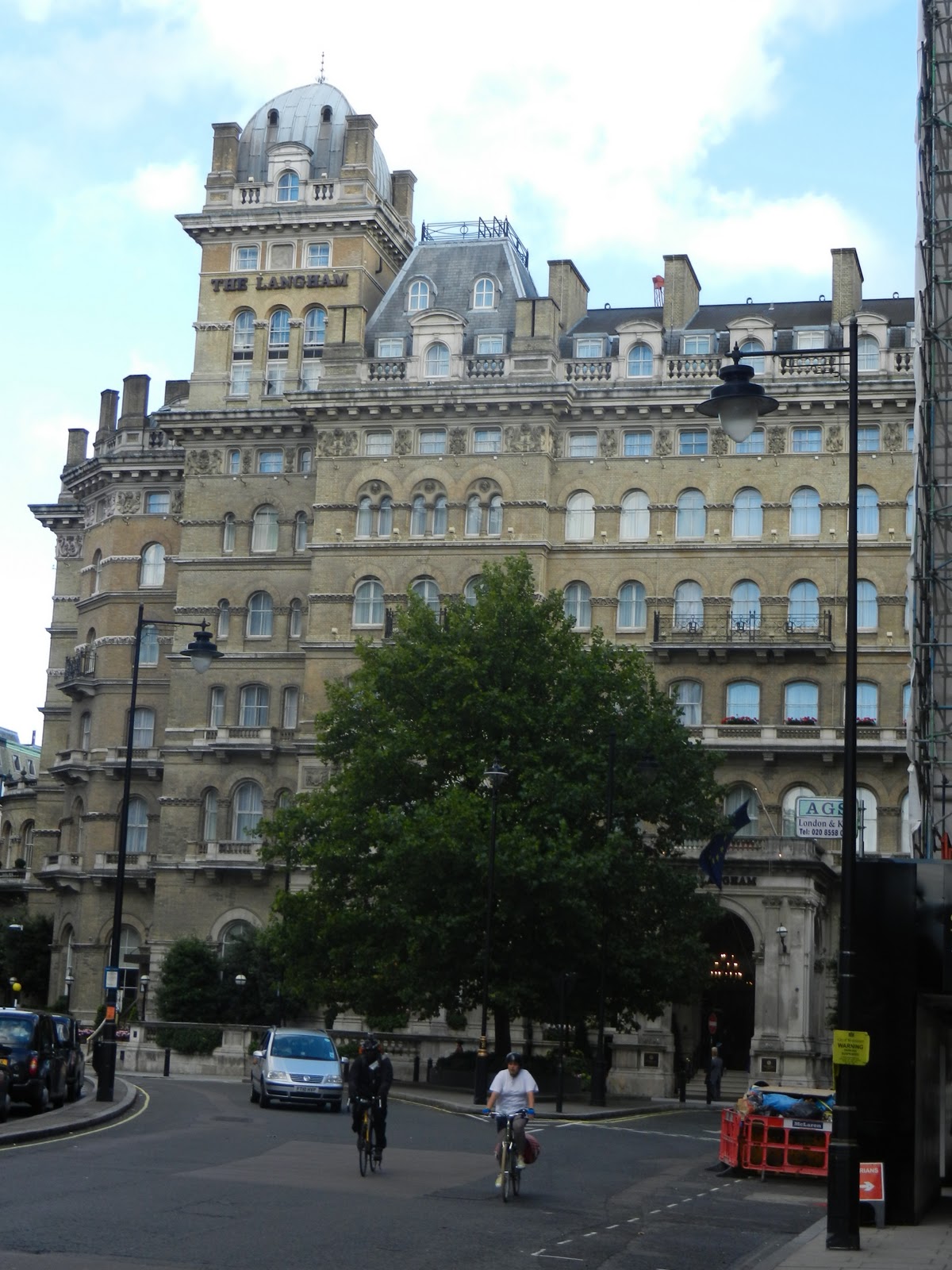
Heading east, after a while, we reach the Langham Hotel at Portland Place. It was here in this lavish hotel that Sir Arthur had received the commission for writing The Sign of Four - in the same meeting with the publisher which earned Oscar Wilde his commission for The Picture of Dorian Grey. Doyle used the same location as the place where Captain Morstan stays in the novel. There are other Holmes characters who take rooms in the same hotel – the King of Bohemia in A Scandal in Bohemia and the Hon. Philip Green in The Disappearance of Lady Frances Carfax. The hotel stands on Regent Street.

Scaffolding on Regent Street
Regent Street is, again. filled with Holmes incidents. In The Hound of the Baskervilles Holmes notices a can following Sir Henry Baskerville. The cabman later reveals that the pursuer had given his name as Mr. Sherlock Holmes.One can walk south down Regent street for around 20 minutes, enjoying the bustle an crowd and shopper’s splendour. Alternatively one can take Bus 12 or the Bakerloo Line tube to Picadilly Circus. Either way, one reaches 68 Regent Street, the site of Cafe Royal, in front of which Holmes is nearly killed by two men armed with sticks in The Illustrious Client. The two assailants escape by making their way through the establishment.  The problem with London at the moment is that as part of a beautification project gearing it up for 2012 Olympics, much of it is under scaffolding. So, this site may be hidden from the most incisive of investigative eyes.

The Critierion
However, a small distance ahead, at Piccadilly, we come to the Criterion theatre. In the first Sherlock Holmes novel, A Study in Scarlet, Watson is having a drink in this plush bar of Picadilly Circus when he bumps into young Stamford, and is told that a gentleman named Sherlock Holmes, a rather strange type, is looking for someone to share rooms.


Further south, we arrive at The London Library in St James Square, where Watson ventures to get hold of a goodly volume on Chinese pottery to help Holmes entrap Baron Gruner in The Illustrious Client.

Entrance to
the Athenaeum
Approaching Pall Mall, one comes across the Athenaeum, perhaps the inspiration behind the Diogenes Club, frequented by his gifted but laid back brother Mycroft.  Holmes meets Mycroft in The Greek Interpreter and tells Watson that his brother is “one of the queerest men” whose deductive powers far exceed his.


Going down towards the Mall, we run down the Duke of York Steps. In His Last Bow,  Baron Von Herling and Von Bork discuss getting a signal book through the "little door on the Duke of York steps".

Turning left past the ICA and heading along the Mall, we soon reach the Arch of Admiralty, which was ‘buzzing like an overturned beehive’ after the theft of the top secret submarine documents, the Bruce-Partington Plans.


From there to the Scotland Yard headquarters of the Metropolitan Police is a short walk. When first mentioned in the Holmes stories, they were based in the alleyway Great Scotland Yard, having since relocated to St. James Park.
At 16 Whitehall, when one comes back towards Charing Cross, stands the Lord of the Moon Mall. Earlier, it had been the Cox and Co., in whose vaults there was the travel worn and battered tin dispatch-box with John Watson painted upon the lid in Thor Bridge. Watson also kept the papers that recorded the Holmes cases in the box.

Further ahead, Charing Cross is the station from where almost all fictional characters have boarded trains to distant parts of England, Holmes and Watson being no exception. They take a Charing Cross train for Marsham in The Abbey Grange and for Chatham in The Golden Pince-Nez. However, in a rare bout of self criticism, Holmes declares in The Man with the Twisted Lip that he ought to be kicked from Neville St Clair’s home at Lee in Kent to Charing Cross for his unpardonable tardiness in thinking out the solution to the case. Irene Adler sets out from here on the 5.15 to the continent after outwitting the King of Bohemia and Holmes himself. In The Second Stain ‘a woman answering to the description of’ the Creole Mme Fournaye ‘attracted much attention at Charing Cross station by the wildness of her appearance and the violence of her gestures.’

However, what remains a mystery is why Mathews ‘knocks out the detective’s left canine in the waiting room of Charing Cross’ since it is made known to us only as an aside while Holmes researches villains with names starting with M in The Empty House.

On the Strand by the Charing Cross station also stood the Site of the American Exchange. In A Study in Scarlet, the police found two letters from the Guion Steamship Co., ‘one addressed to E.J. Drebber and one to Joseph Stangerson’ address American Express Strand. This used to be a kiosk outside the station, which Americans in London could use as a postal address. It is outside the station by the Exchange that in The Illustrious Client Watson catches a glimpse of the shocking headline on the newspaper being displayed by the one legged news vendor –‘Murderous attack on Sherlock Holmes’.

On the Strand at Charing Cross Station stands the Charing Cross Hotel, where Holmes sets a trap in the smoking room for Oberstein, the spy in The Bruce-Partington Plans, and prevents the top secret submarine papers from falling into enemy hands.

Behind the Charing Cross, at Northumberland Street at Craven Passage, there stands The Sherlock Holmes, a pub whose walls are full of manufactured memorabilia of the detective, including brier pipes and bent poker sticks.  There are also superb cuttings of a group of American men in the semaphoric positions of the characters in The Dancing Men welcoming Conan Doyle to a stateside town.  Upstairs there is a life size reconstruction of the sitting room of Holmes and Watson in Baker Street. Some even say that the pub, formerly Northumberland Arms, is actually the Northumberland Hotel where Sir Henry Baskerville stays in The Hound of the Baskervilles.

Behind this establishment used to stand, a century ago, Neville’s Turkish Baths, which Holmes and Watson visit at the start of The Illustrious Client, the date mentioned as 3rd September, 1902.
Coming back to Strand, we can extrapolate the site of the Charing Cross Post Office at no. 457. In Wisteria Lodge, John Scott Eccles makes himself known to Holmes by sending a telegram from this Post Office. Inspector Gregson finds Eccles by tracing the telegram to the old post office.

Walking ahead, the Craven Street cuts in. 43-46 of this street housed the Craven Family Hotel, based on which, in all probability, Conan Doyle wrote of the fictitious Mexborough Private Hotel, where Stapleton keeps his wife a prisoner in The Hound of the Baskervilles.
 Opposite the Charing Cross Station on the Strand, Watson dashes out of a cab through Lowther shopping arcade and into another cab on the other side as part of an elaborate getaway route during Holmes’s escape from Moriarty’s gang in The Final Problem. Lowther was demolished in 1904 and a branch of Coutt’s Bank has since been built on the site.
Walking east along Strand, we come to Agar Street at Chandos Place, which was the site of Charing Cross Hospital. On Dr. Mortimer’s walking stick, which he left at 221B Baker Street at the beginning of The Hound of the Baskervilles, is inscribed ‘from his friends of the CCH’. Holmes is also taken to the same hospital after being attacked outside the Cafe Royal in The Illustrious Client.

Further ahead, on Wellington Street, we come across the Lyceum Theatre, currently showing the spectacular stage version of Lion King. The future Mrs. Watson, Mary Morstan, meets an agent for the Sholtos, who have been sending her jewels from her late father’s treasure in The Sign of Four. A slight mix up of the dates of the appointment by Conan Doyle resulted in a four wheeler driving Morstan, Holmes and Watson from Wellington Street to Sholto’s Brixton villa through Rochester Row and Vincent Square, Westminster,  instead of straight over Waterloo Bridge.

It is from the aforementioned Waterloo Bridge that John Openshaw drowns in the water, probably murdered by the Ku Klux Klan, in The Five Orange Pips – a tragedy which, arguably, is Holmes’s single greatest failure.

Poppin's Court
As we merge onto Fleet Street, we spot Poppin’s Court. The Red Haired League’s ginger haired pawnbroker Jabez Wilson sat in an office in Pope’s Court, copying out the Encyclopaedia Britannica for the then grand sum of four pounds a week. Pope’s court was possibly based on Poppin’s Court.

Further ahead, heading east to Old Bailey and then Northwards, we come to Giltspur Street. Ahead of us stands Bart’s, or St Bartholomew’s Hospital, where Dr. Watson meets Sherlock Holmes for the first time in a chemical laboratory in the first story involving the detective The Sign of Four. A plaque on the wall of the curator’s room adjoining the hospital’s pathology lab claims that Holmes’s first words to Watson had been, “How are you? ... You had been in Afghanistan, I perceive.” This is more like the great detective and sticks to the memory, but the fact of fiction is that Holmes has already said to both Watson and Stamford, “I’ve found it, I’ve found it. I have found a re-agent which is precipitated by haemoglobin and by nothing else.” However, despite all the euphoria and excitement, the finding is never referred to again.

Restricted to a small part of London notwithstanding, it becomes a long, long walk ... from his established home in Baker Street to the arrival of Holmes on the scene – at the Bartholomew Hospital. And it is a wonderfully mysterious way to see parts of London on foot.


Arunabha Sengupta is the co-editor of Scroll and the author of three novels, the latest being The Best Seller

Wodehouse at the wicket while Sir Arthur Bowls

by Senantix

P.G. Wodehouse and Arthur Conan Doyle did not only share the premises and cover space of the Strand Magazine, but shared the dressing room at Lords as well.


It is not very well known, but both of these supreme scribblers who have delighted readers for more than one hundred years were also very keen cricketers.

In fact, Sir Arthur was a first class cricketer of some ability. Wisden says in his obituary that “while never a famous cricketer, he could hit hard and bowl slows with puzzling flight. For MCC v Cambridgeshire at Lord's, in 1899, he took seven wickets for 61 runs, and on the same ground two years later carried out his bat for 32 against Leicestershire, who had Woodcock, Geeson and King to bowl for them.”

It is of curious interest that his only wicket in first class cricket was of a batsman by the name of W.G. Grace. The creator of Sherlock Holmes got the great man caught by the wicket keeper.

P.G. Wodehouse, although never a first class cricketer, did play with some distinction for Dulwich College. In the first eleven in 1899 and 1900, he once took 7 for 50 against Tonbridge as a fast bowler. His eyesight, though, stood in the way of pursuing greater feats with bat and ball, and hence the typewriter perhaps took over. However, some years later, he took up a position in the Emsworth House School in the Hampshire town of Emsworth, and his main responsibility was to help the boys with cricket. He often turned out for the Emsworth sides, and it is of scarce wonder that one of the most lovable earls of his canon is named after the town.

Wodehouse and Conan Doyle also played cricket for the curiously named Allahakbarries, a team founded by J.M.Barrie, named after the African word meaning ‘Heaven Help Us’ consisting of literary men who played against the various villages in the Home Counties.

PGW later gravitated to golf, his other great passion and the theme for many a book. However, he does recall that the days before all the controversy of broadcasts and internment camp life during second world war he was having a good time playing cricket after many years, confounding batsmen with excellently pitched leg breaks.
The two men were the mainstay of not only the Strand Magazine, but also the cricket teams fielded by the Authors to take on the might of Publishers and Actors. At Lords in 1902, Conan Doyle captained the Authors side against the Publishers, and a twenty one year old P.G. Wodehouse was one of the better players of the wordsmiths.

It is no surprise then, that some of the works of both these men feature the pure English game, and sometimes cricket becomes the main theme in the stories.
Sir Arthur’s collected poems are not as well known as his Sherlock Holmes, Dr. Challenger or Brigadier Gerard stories. However, one of his poems contains a wonderful account of how he got WG caught off his bowling when the ‘wicketkeep’ Storer made sure of a terrific skier from a ball that the Doctor had diagnosed incorrectly. The poem is reproduced in at the end of this article.

Late in his life, Conan Doyle wrote the story of Spedegue’s dropper, published as one of the ‘other stories’ with Maracot Deep. Sepdegue, the hero of the tale, develops an underhand delivery, a lob flung high enough in the air to come down at the pace of a fast bowler. It was like fast bowling delivered from above, attacking the batsman vertically. When he achieved accuracy, Spedegue won a famous Test Match for England against Australia.

Sir Arthur’s other reference to cricket was in one of his Brigadier Gerard stories, where he describes a French officer’s rather calamitous efforts at the game as a prisoner of war.
However, Conan Doyle did have a rather peculiar peeve about left-handers, contending that left-hand batting should not be permitted since it held up the game.

P.G. Wodehouse,during  the beginning of his career when he wrote school stories, did write a full cricket novel, Mike. Mike Jackson, the hero and a friend of his latter day adult protagonist Psmith, hailed from a family of first class cricketers, three cricketing brothers. In the novel, he plays for his school eleven and ultimately scores a century in a first class match.

In Psmith in the City, cricket again features prominently, and Mike’s batsmanship is reinforced by Psmith himself who turns out to be a canny left arm spinner and a tail end batsman who hits the ball with something approaching the tee shots of golf.

In the rather rare editions of P.G. Wodehouse’s poetry one finds his fascination with the game becoming more manifest.
In a small poem titled MCC, he writes:
In speaking of our cricketers,
                This maxim guideth me,
If they win a match the’re England,
                If they lose they’re MCC.

There are some delightful humorous poems about cricket – The Outcast – A Tale of a Ladies’ Cricket Match, Missed, The Umpire...
However, it is in one quaint little poem entitled The Cricketer in Winter that his affection and romanticism for the game is most apparent.
Things of the past are drive and cut,
With which erstwhile we would astound men;
The gay pavilion’s doors are shut;
The turf is given up to groundsmen;
Gone is the beautiful length ball,
Young Wodehouse as a cricketer
Gone too the batsman who would snick it
Silent his partner’s cheery call.
Football usurps the place of cricket.        
...
Or, if in vein for gentle toil,
Before he seeks a well earned pillow,
He takes a flask of linseed oil
And tends his much-enduring willow,
Feeling the while, what time he drops
The luscious fluid by degrees on,
Given half-volleys and long-hops,
How nobly it will drive next season.


In the Trent Bridge Pavilion hangs the framed picture showing
Sherwin ad Shacklock at the two ends of the middle row
It is another remarkable similarity between the two masters that the most celebrated characters created by both had cricketing origins. Sherlock Holmes is supposedly named after two Nottinghamshire cricketers, Sherwin and Shacklock. When Shacklock played for Derbyshire, his fellow fast bowler was William Mycroft, after whom Conan Doyle named the brother of Holmes.

 Jeeves originated after the name of Warwickshire county ricketer Percy Jeeves, a fast medium bowler killed in action during the First World War. Wodehouse was enjoying a short holiday in Wensleydale, and happened to come across a cricket match at Hawes where Percy Jeeves was playing and thought the name would be ideal for one of his characters

Although we have limited our discussion to two giants who strode the Strand, there have been plenty of other hallowed literary names who have once in a while or often come down and graced the great game with their powerful pens. The names include Lord Byron, Anthony Trollope, Charles Dickens, Thomas Hughes, Rupert Brooke, Robert Graves, Ben Travers, J.M.Barrie, A.A, Milne, Ernest William Hornung (Raffles was a cricketer of repute) and Samuel Beckett (another first class cricketer). E.V. Lucas, Tom Stoppard and Harold Pinter.

However, one exception was Geroge Bernard Shaw who was caught napping to an innocent half volley.
Asked by a reporter in 1908, “Who do you think will win the test?” his reply was, “What are they testing?”

A Reminiscence of Cricket – Sir Arthur Conan Doyle
(an account in verse of how the great writer got the wicket of the great cricketer in a battle of part time doctors)
Once in my heyday of cricket,
 One day I shall ever recall!
 I captured that glorious wicket,
 The greatest, the grandest of all.

 Before me he stands like a vision,
 Bearded and burly and brown,
 A smile of good humoured derision
 As he waits for the first to come down.

 A statue from Thebes or from Knossos,
 A Hercules shrouded in white,
 Assyrian bull-like colossus,
 He stands in his might.

 With the beard of a Goth or a Vandal,
 His bat hanging ready and free,
 His great hairy hands on the handle,
 And his menacing eyes upon me.

 And I - I had tricks for the rabbits,
 The feeble of mind or eye,
 I could see all the duffer's bad habits
 And where his ruin might lie.

 The capture of such might elate one,
 But it seemed like one horrible jest
 That I should serve tosh to the great one,
 Who had broken the hearts of the best.

 Well, here goes! Good Lord, what a rotter!
 Such a sitter as never was dreamt;
 It was clay in the hands of the potter,
 But he tapped it with quiet contempt.

 The second was better - a leetle;
 It was low, but was nearly long-hop;
 As the housemaid comes down on the beetle
 So down came the bat with a chop.

 He was sizing me up with some wonder,
 My broken-kneed action and ways;
 I could see the grim menace from under
 The striped peak that shaded his gaze.

 The third was a gift or it looked it-
 A foot off the wicket or so;
 His huge figure swooped as he hooked it,
 His great body swung to the blow.

 Still when my dreams are night-marish,
 I picture that terrible smite,
 It was meant for a neighboring parish,
 Or any place out of sight.

 But - yes, there's a but to the story -
 The blade swished a trifle too low;
 Oh wonder, and vision of glory!
 It was up like a shaft from a bow.

 Up, up like a towering game bird,
 Up, up to a speck in the blue,
 And then coming down like the same bird,
 Dead straight on the line that it flew.

 Good Lord, it was mine! Such a soarer
 Would call for a safe pair of hands;
 None safer than Derbyshire Storer,
 And there, face uplifted, he stands

 Wicket keep Storer, the knowing,
 Wary and steady of nerve,
 Watching it falling and growing
 Marking the pace and curve.

 I stood with my two eyes fixed on it,
 Paralysed, helpless, inert;
 There was 'plunk' as the gloves shut upon it,
 And he cuddled it up to his shirt.

 Out - beyond question or wrangle!
 Homeward he lurched to his lunch!
 His bat was tucked up at an angle,
 His great shoulders curved to a hunch.

 Walking he rumbled and grumbled,
 Scolding himself and not me;
 One glove was off, and he fumbled,
 Twisting the other hand free

 Did I give Storer the credit
 The thanks he so splendidly earned?
 It was mere empty talk if I said it,
For Grace had already returned.
-- Sir Arthur Conan Doyle

Click here for the sports blog of Senantix - the avatar of Scroll co-editor Arunabha Sengupta on blogosphere