Showing posts with label Aisoorya Vijayakumar. Show all posts

Saturday, 31 December 2011

Chaos and Cap'aphony

Feature Column on Chaos Theory 
by Aisoorya Vijayakumar

More chaos, and even more clutter

The persistent Kawphi girl and her hapless faculties are at their game, trying mighty hard to unravel the puzzling complex mysteries of the chaos theory. They are in the midst of fathoming the deep definitions of fractals, and her left brain tries, mostly in vain, to enlighten her right brain on the wondrous possibilities of fractals.

Thud thud thud! Kawphi girl bangs the table with her weary fists in one of her feeble attempts at ensuring that all the information pouring in from the left-brain doesn’t drain out through her ears. One recollection of the memories of the frog-faced exam supervisor sends her faculties – the left-brain, the mind, and the right brain, scurrying off to assemble all their learnings together.

The mind (ever the strict commander): ‘Alrighty fellas! Let’s learn about the fractals. We have four more hours to go before the exam!

Right brain: Woohoo! I’m all set. Left brain, pal, have you learnt to speak human, or do you still resort to speaking incomprehensible gibberish?

Left brain: Right-brain, let’s be serious! This calls for some united defense.

Right brain: Goodness left-brain, pal, can’t you take a joke?! Fine, what’s on our cards?

Mind: What we need to do is stay focused on the subject.

Left-brain: …And not indulge in some mass delusional yapping about substantiating our individual contentions on our apparent preeminence in cognitive capabilities!

Right brain (with a muddled expression): Err… Not indulge in what?

Left brain: It’s tough to be me! Having to deal with retarded other-halves!

Right brain (Advancing menacingly towards the left brain): You speak with an outlandish resolute conviction of a lunatic intent upon using all possible words in your sentences, irrespective of whether they make sense or not, and you have the audacity to call ME a retard?!

Mind: Aww, cut that out you two! I told you! FOCUS!

Left brain: Right! So, fractals, as we were discussing, are, in simple terms, fragmented patterns of similarity. What I have read so far on this is that, Mandelbrot is credited with having brought some illumination and clarity into what most people believed to be amorphous – the mathematical patterns of predictable and unpredictable occurrences in the world.

Mind: Hmmm, and was there any specific science that at least tried to comprehend this before Mandelbrot’s days?

Left brain: Maybe not comprehend per se, but the field of Euclidian geometry encompassed the study of realizing perfections in abstract forms that was nearly non-existent back then. And what Mandelbrot theoretically did was envisage and foster a method for observing and mathematically defining many nebulous natural phenomena.

Right brain: Such as?

Left brain: Such as, for instance, cloud shapes, coastline patterns, and so many more.

Mind: When did all this start?

Left brain: You see, this was one of those serendipity breakthroughs. I read in the Telegraph that Mandelbrot, a research fellow with IBM, started a series of analyses in the 1960s, of electronic "noise." His experiments began because this noise seemingly meddled with IBM’s other electronic transmissions. He and his team noted that the glitches and interferences occurred in clusters, and that these clusters also formed a pattern. Each period of interferences and the periods of smooth transmissions, when enlarged, mimed the overall pattern of the large scale graph as well. They called this a “self-similarity.” Mandelbrot further demonstrated the occurrence of such patterns in other areas such price curves, coastlines , and so on.
In a viewpoint-turning pivotal essay that he called How Long Is the Coast of Britain? (1967), Mandelbrot stated his points and observations on fractals in coastlines.

Right brain: Yaay! The left brain gets this year’s award for non-stop rattling nonsense. Really! Left-brain, did you mug that up all by yourself or did you take a drug?

Mind: You, again!!!

Right brain: Well what the heck am I supposed to gather from that load of lines?

Left brain: Well, let me show you some classic examples of what I mean. I found these in the pages of University of Wisonsin, Madison.

Look at how each of these patterns in nature are self-similar, each smaller fragment being a replica of the overall figure.


The Cantor Set


The Koch Curve


The Sierpinski Gasket


A Dragon


The Cantor Maze


A Twig


A Crystal


A Snowflake


A Tree


The Barnsley Fern

Right brain and Mind (in unision): Wow!!!!

Left brain: That’s not all. You can still see instances of these fractals in the rich offerings of nature everyday. Look what I found in the archives of the WebEcoist Site – Nature's Examples for Fractals.

Mind: This is mind-blowing. What does it mean? The word – “fractal?”

Left brain: Mandelbrot is said to have coined this term from the Latin word frangere which means “to break.”


…. The Kawphi girl faculties would continue to study the chaos theory tirelessly amidst all the din and pandemonium, and all you need to do is visit this column in the next issue to get to know about the progress the team makes…


Movie Review - Angels in the Outfield


Ya Gotta Believe!

Rating:  7/10
Reviewer: Aisoorya Vijayakumar

What


Angels in the Outfield – a comedy on baseball, faith and hope that runs close to 1 hr 45 minutes with a surprising PG rating (considering that in the present day, parents are the ones who need their children's grudging guidance in understanding the expletives rampant in what are deemed to be today's civilized movie masterpieces).
Produced by Irby Smith, Joe Roth, and Roger Birnbaum, and released and distributed by Walt Disney Pictures, the movie was conceived as a fresh modern-day version of the 1951-classic of the same name.
Who?
It stars Joseph Gordon-Levitt, Danny Glover, Christopher Lloyd, Brenda Fricker, Tony Danza, Matthew McConaughey, and many others. Carney Lansford, a former baseball player (California Angels, 1978-1980), decided to try his hand at a different game altogether when he starred as Kit "Hit or Die" Kesey in this movie.
The movie was directed by William Dear, best known for his not-just-run-of-the-mill films, Harry and the Hendersons, Wild America, and If Looks Could Kill. Dear was lent help by Randy Edelman who scored the music, and Matthew Leonetti who wielded the camera.
Dorothy Kingsley, George Wells, and Holly Goldberg penned the screenplay , leaning on the original 1951-script and screenplay by Dorothy Kingsley, George Wells, and Richard Conlin, for support.

When?
Released on July 15, 1994.
How did the movie fare?
Rotten Tomatoes gave this movie a 40 % rating on its tomatometer. Despite the movie facing an identity crisis battle with some critics crushing the moviemakers, calling the movie a childish downright waste-of-time as in the case of Reel Reviews, cynicism could not really hold this movie back from winning the hearts of many.
Did we like it?


At some points, a doubtful not-so-loud 'Yes' but at many, a resounding 'Of course!' In order to look at the movie objectively, one should really grasp what they try to tell us at the end of it all – “ya gotta believe” – may be not in Omnipotent Divinity, but in oneself! Because, as the chief angel in the movie says, when it really matters, no angel helps you out and “Championships have to be won on your own. It's a rule.”
Let's dissect the movie to decide if it would be a worthwhile watch.
Fire (the plot and theme): The movie lies on a very unassuming frame with no intrigue what-so-ever. The plot, as such, is no mighty task to untangle and revolves around Roger and JP, sheltered in a foster home. His father's sarcastic and casual remark that they would be 'family again' when the California Angels win the baseball pennant seeds colorful hopes in Roger's heart, who fervently prays for heavenly intervention in the scheme of things. On hearing his plea, a team of angels led by Al, descend to diminish the angst from the boy's mind. The angels weed out the insecurities and indifferences that the baseball team seems to be pregnant with and pave the way for them to climb to the top of the rankings. Do the angels go on to win a momentous victory in the yearly tournament and make Roger’s prayers come true?. At the risk of sounding very far-fetched, the plot talks about a series of monumental events that change the life of a whole team, all in answer to a child's prayer. With the characteristic flaws that any happily-ever-after script and screenplay would possess, this one too plays right into the hands of critics to claim that the storyline leaves much to be desired.
Water (characterization and narration): The transformation of a grumpy old baseball team manager to a tender 'grandpa'ish man who plays with the neighborhood kids is a lifetime journey, beautifully brought to life in the character of George Knox. But the integrity thrust on the actors gets more than what you can digest beyond a point and one has only a caustic-tongued snobbish commentator for company. The villainy in the latter comes almost as a breath of fresh air when one gets suffocated being amidst a bunch of do-gooders. The movie's pace is wonderful, neither tauntingly slow, nor dazingly fast.
Air (actors and performances): Danny Glover needs to be lauded for his portrayal of a cranky, ever-swearing, impatient-to-death baseball team manager, George Knox. Gordon-Levitt shows precocious maturity with his acting prowess in his role of Roger, the boy who makes it all happen. Fricker and Lloyd have done their roles to prefection, as the foster home caretaker and the chief angel respectively, and have blended with their roles. The support cast, though not really etching themselves in memory, have done convincingly good jobs.
Earth (music and camera): Music deserves a bow in this venture. Never too dreamy, never too raspy, it soothes pained nerves. Cinematography is exceptionally good, with the animated angel sequences with human faces seamlessly blending into the mainstream action. Graphics have been paid careful attention to, as explicit in Al the angel's maneuvers.
Space (dialogues): Witty and memorable. The painstakingly tailored dialogues match the capabilities of a 12-year-old teary-eyed boy, as they do a funny morally right angel, not to speak of a grouchy old man who thrives on blasphemy and personal insults. Some lines which fail to fade from the memory include -
God... if there is a God... if you're a man or a woman... if you're listening, I'd really, really like a family. My dad says that will only happen if the Angels win the pennant. The baseball team, I mean. So, maybe you can help them win a little. Amen. Oh, A-woman, too.“ (Roger Bomman)
You don't think as a team, you don't play as a team, you don't even LOSE as a team!” (George Knox)
You can't go through life thinking everyone you meet will one day let you down.” (George Knox)
We're 'AL'ways watching!” (The movie's finishing lines by Al the Chief Angel)
What's our verdict?
The movie steers clear of most of the expected frivolities such as bad acting, bad background scores, bad dialogues, and bad treatment, and has elicited only the best from the crew. Given the challenges in penning a dreamy script, we think the movie deserves a 7 on 10 rating,
So, given! The movie doesn't try to wear a preachy cloak and make us all believers at one go. But, as JP says, “it could happen!”


Pictures Source: Internet. (Please write to us if there are any copyright infringements on the pictures.)

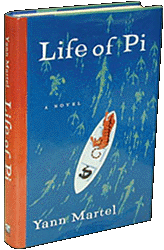
Book Review - Life of Pi


A tale of incredible grit in truly testing times of adversity

Rating: 7.5/10
Reviewer: Aisoorya Vijayakumar

What

Should this book be deemed to be a fantasy, given its entrancing, yet far-from-credible, storyline? Or should we designate it as an epithet of growing up philosophies, as felt by a surprisingly erudite 16-yr-old protagonist? Maybe we should mark this as a book of daring adventures and (literally!) wild confrontations, where the very belief in survival is fighting a game of double jeopardy. This abashing work gives rise to all these and a lot more questions and one finds it bewilderingly hard to characterize this novel as anything in particular.
Stupefying though it may sound, it is said to have been rejected by close to five publishing houses, before Knopf Canada decided to promulgate this novel by publishing it.
It went on to be critically and thunderously acclaimed, and of all the plentiful laurels it received, what stays in one's mind is that it won the man booker prize for fiction in 2002.
Who?
Written by Yann Martel, the tale revolves around a life-changing 227-day journey on a lifeboat, that a 16-year-old Piscine Mollitor Patel (in short, Pi) undertakes, in the alarmingly frightening company of a 400-pound-bengal tiger.
When?
Released in Sep 2001. The story is set in 1977, in Pondicherry, a former French-colonised Indian union territory. All the places cited in the novel are for real and form an integral part of India's delightful past and present.
How did the book fare?
The novel made heads turn, no doubt! And turn dangerously wide angles at that! Till date, most readers give the impression of utter predicament if asked how they liked the book. Torn between having to decide on a yes or a no, for a book that some think borders on incongruity, their dilemma is written painfully clear for all to see. The Guardian's review was a compound of admiration and nihilism. And BBC's Finlo Rohrer's review made it amply vivid that the entertainment staff of the establishment did not get amazed by Martel's prowess.
Did I like it?


It's immensely difficult to not find this formidable book remarkable, if not exquisite. So for the very reason that the book stands for its convictions amidst mundane monotony - yes, I did like it.
As the book begins – (Coffee Bean's reaction) One eyebrow raised 1/8th of an inch, Jeeves style – So this ultra-smart kid Pi, blessed with splendid insight is drowning in his self-glories! Ouch! So much for the hype! The boy needs an immediate dose of emergency humility. The take on animal life and time-surpassing questions on the moral ethicity of imprisoning animals in zoos are memorable though. And so are his lines on spirituality. For all his repulsive narcissism, the boy does have brains.
As the plot unfolds - (Coffee Bean's reaction) Alright, the boy and his parents are setting sail to Canada with their zoo animals. The ship sinks and the boy survives, with a zebra, a hyena, and an orangutan on a life boat and urges Richard Parker to latch on as well. Can they survive the journey of 227 days on that pitiable lifeboat at all? That forms the story which blends fleeting emotions and adventure.
When Richard Parker's identity is revealed, both my eyebrows were raised at the turn of events – A bengal tiger on a life boat?!! Whoa! A 16-yr-old Pi and a 400-pound Parker. If only the knot of this had hit the heads of some well-admired moviemakers I can think of. What a temptingly 'cute' setting to delve into the onset of a crude, chilling, and yet cherishable friendship. I can almost even hum the violin score on the background as their relationship evolves into the millennium’s tauntingly sensational (another bit of female chorus vocals here) story of a lovely bond! As Shakespeare's lines go, “That ends this strange eventful history!”
But thankfully, Martel has kept this scary temptation in check and has narrated the difficulties and delusions of this situation. How Pi and Parker thrive and how you want to read between Martel's lines to digest the complete implications of his tale is up to you, as the reader. There are lessons to learn, and then there are lessons to remember. The cynics might allegorize this, the believers might plunge headlong inside, the critics might objectively butcherise this, and the weak-hearted might give up on this early on. Whichever way one looks at it, the story is undeniably enthralling.
Lines that caught my wandering attention:
The reason death sticks so closely to life isn't biological necessity—it's envy. Life is so beautiful that death has fallen in love with it, a jealous, possessive love that grabs at what it can.
To choose doubt as a philosophy of life is akin to choosing immobility as a means of transportation.
For evil in the open is but evil from within that has been let out. The main battlefield for good is not the open ground of the public arena but the small clearing of each heart.
I did not count the days or the weeks or the months. Time is an illusion that only makes us pant. I survived because I forgot even the very notion of time.
There were many seas. The sea roared like a tiger. The sea whispered in your ear like a friend telling you secrets. The sea clinked like small change in a pocket. The sea thundered like avalanches. The sea hissed like sandpaper working on wood. The sea sounded like someone vomiting. The sea was dead silent.
If you stumble at mere believability, what are you living for? Isn't love hard to believe?
Don't you bully me with your politeness! Love is hard to believe, ask any lover. Life is hard to believe, ask any scientist. God is hard to believe, ask any believer. What is your problem with hard to believe?
What's the verdict?
The book definitely is in the list of my thousand-books-to-read-before-you-die list. Alright that 'thousand' was wistful exaggeration, but am sure you get the point! It may not be every reader's favorite, but the book does give one a lot of rhyme and reason to look into oneself and check what one believes in. For steering away from age-old conventionalities and for a capital clarity in thoughts and words, the book deserves a 7.5 on 10.

Pictures Source: Internet. (Please write to us if there are any copyright infringements on the pictures.)